advertisement
4 Moves This Pilates Instructor Uses to Train the Super Bowl’s Top Stars
Fitness
4 Moves This Pilates Instructor Uses to Train NFL’s Top Stars of Super Bowl 2025
Here’s how regular practice helps the Kansas City Chiefs stay in shape.By Danielle ZicklFebruary 7, 2025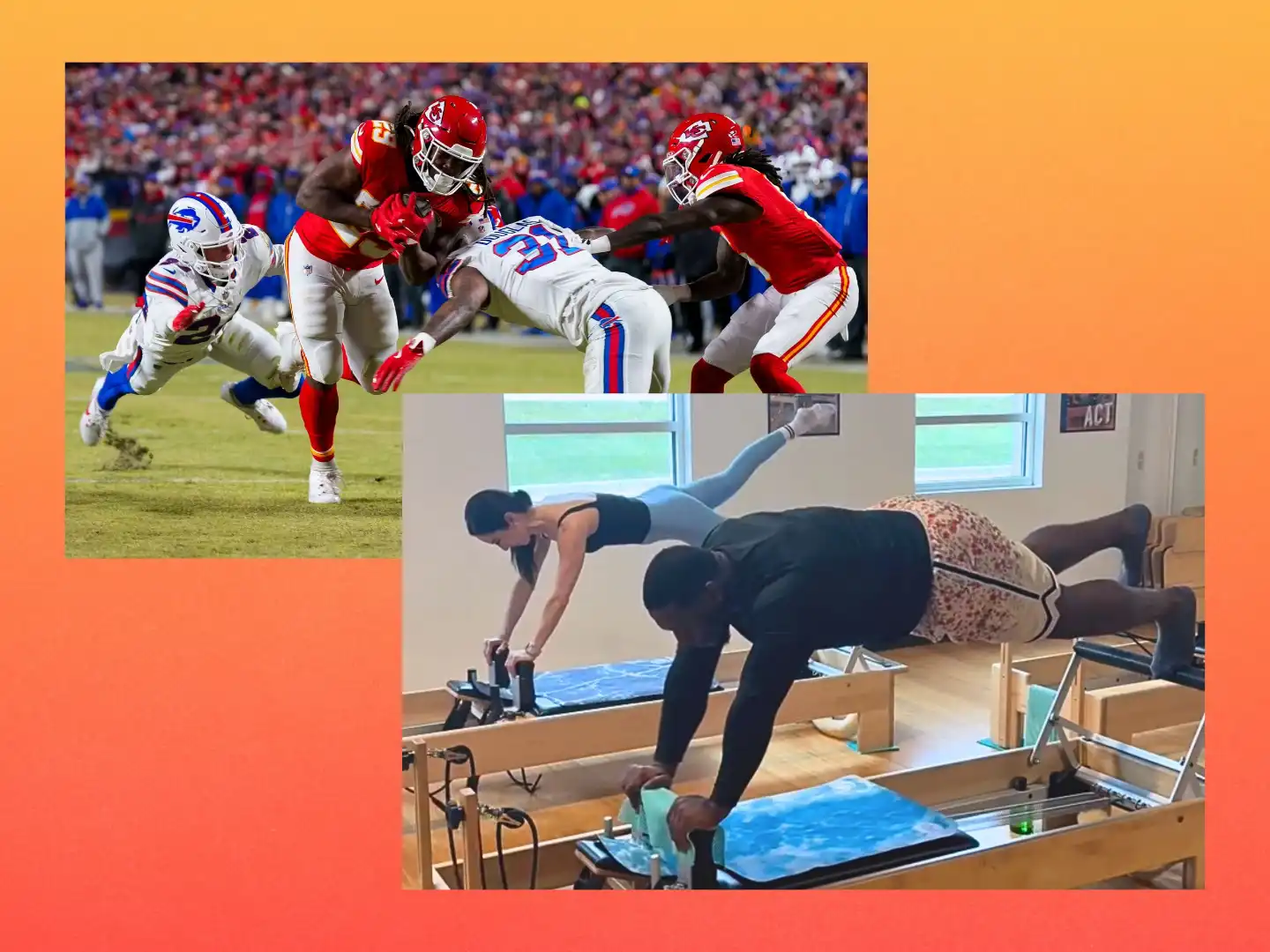
All products featured on Self are independently selected by our editors. However, we may receive compensation from retailers and/or from purchases of products through these links.
If you feel like everyone is doing Pilates nowadays, well, you might be onto something. According to ClassPass’s 2024 Look Back Report, that was the number one booked class globally. Among the crew of Pilates devotees? The Kansas City Chiefs.
In fact, their studio, Pilates By Kahley in Overland Park, Kansas, went viral last year when ESPN shared a video of a few Chiefs players putting in the work on the reformer. But it wasn’t a one-and-done workout for the NFL stars: The players are still at it this year as they gear up for Super Bowl LIX, where they’ll be taking on the Philadelphia Eagles.
So what is it about the popular (yet surprising) exercise modality that has the Chiefs stretching for more? We tapped their instructor Kahley Schiller to find out.
SELF Healthy Eating
Get nutrition tips, delicious recipes, and inspo for your grocery list delivered to your inbox just in time for your weekly meal prep.SIGN UPBy signing up, you agree to our user agreement (including class action waiver and arbitration provisions), and acknowledge our privacy policy.There are actually a few good reasons football players should add Pilates to the mix.
Before we get into the benefits of Pilates for football players, let’s take a step back into thehow—meaning, how did these top NFL athletes find their way into the studio in the first place?
It all began about 14 years ago, when quarterback Trent Green’s wife, Julie, started taking classes at Schiller’s studio. “She convinced him to start doing Pilates, so that was my first big Chiefs person,” Schiller tells SELF. “Word of mouth is everything, and it kind of grew from there.”
Since then, she’s trained both offensive and defensive players, including Tershawn Wharton, a defensive tackle who’s been influential in introducing many of his fellow defensive linemen to Pilates over the last five years. As you can tell from a quick scroll of Schiller’s Instagram, you can also count on seeing players like Derrick Nnadi and Malik Herring frequenting the studio too.
When you think of NFL workouts, you probably think of agility drills or super heavy bench presses. So if you’ve never associated football with Pilates, you’re not alone. Schiller acknowledges there’s a misconception about who Pilates is typically thought to be “for”—and that NFL players are breaking these stereotypes.
“Joseph Pilates came [to the US] from Germany in the 1920s and opened a studio in New York City,” she says. Pilates soon became popular with dancers as a way to improve technique and rehab injuries. Initially most of the clientele were men, but as the modality grew, more women became involved. Now, if you take a quick scroll through social media—say, for instance, the Pilates tag on TikTok—you can see they’re heavily represented in that space. But tides are starting to change: “It’s taken a while for it to become where Pilates is for everybody.”
And that includes football players. Because the reality is, Pilates isextremelybeneficial for performance on the field. In their everyday training—mainly lifting and HIIT workouts—football players work their larger muscles (say, glutes and quads) that prime them for explosion and momentum, Schiller explains. “Pilates comes in and creates symmetry and balance throughout their entire bodies so that their anterior chain [front of body] and their posterior chain [back of body] are equally as strong, which would make them more powerful,” she says.
According to Schiller, Pilates has helped Wharton feel more stable and strong when he needs to explode out of the three-point stance on the field (a position in which two feet and one hand are on the ground before the ball is snapped). Not to mention, a regular Pilates practice helped him recover from a torn ACL in 2022, she says.
What’s more, Pilates may help prevent injuries in the first place “because you’re strengthening all your muscles versus just the larger ones,” Schiller says. For instance, if you’re doing a heavy back squat, your quads and glutes might go all-in, but if you do the Pilates clams hell exercise, it'll help zero in on the small side-butt muscles (like your hip abductors). As SELF has reported previously, by focusing on the small muscles that support a joint, you can better improve the stability there, which allows for greater (and safer!) mobility.
Lastly, Pilates simply gives you a deeper connection with your body, according to Schiller. “It teaches you how to really work your body, and it teaches you an understanding of how to engage your muscles versus just going through the movements,” she says. “When you’re more in tune with your body, you know how to efficiently work your body, and that brings confidence.”
Schiller’s Favorite Pilates Moves for the Kansas City Chiefs
1. Footwork“I put [the players] in different positions with their feet on the foot bar of the reformer, and then I align their bodies from the feet up,” she says. “It helps them strengthen their feet, ankles, knees, and hips.” On the field, this can help with running speed and tackling, for instance.
Most Popular
Life‘Wicked’ Forced Me to Have a Conversation I Hoped My Daughters Could AvoidBy Jessica Shyba
HealthThe One Thing That Reliably Kills Norovirus and How to Keep it From Spreading in Your HomeBy Erica Sloan
Relationships5 Ways to Feel Less Lonely During the HolidaysBy Hannah Smothers



How to do it:
- With the carriage toward the bottom of the reformer, lie face-up on the reformer with your head on the head rest, your arms by your sides, and your feet on the foot bar.
- Squeeze your core and glutes, then press both feet into the foot bar to push the carriage toward the top of the reformer, extending your legs until they’re straight.
- Bend your knees to slide the carriage back toward the bottom of the reformer.
- Repeat for a set number of reps, then lower your hips back down to the starting position.
“Working on the posterior chain is important too, which is where pulling straps comes in,” Schiller says. You’ll help build strength in pretty much all your posterior chain muscles, which include the rhomboids (upper back), erector spinae (spine), lats (mid back), glutes (butt), hamstrings (backs of thighs), and calves (backs of legs).
How to do it:
- Lie face-down on a Pilates reformer long box with your shoulders at the top edge of the box and your body in a straight line from head to toes.
- Grab a strap in each hand as high up as you can, palms facing down. Make sure there’s no slack in the straps.
- Squeeze the muscles in your upper body, core, and lower body, then pull the straps down and back toward your hips.
- Reach your arms forward to return to the starting position.
- Repeat for a set number of reps.
“Your core is your powerhouse,” Schiller says. “It’s essential for what [the players] do.” Indeed, in order to generate power and explosiveness and prevent being knocked off balance during sacks and tackles, NFL players need a strong core. This exercise strengthens the rectus abdominis (top layer of your abs muscles), transverse abdominis (innermost abs muscle), and obliques (the sides of your abdomen).
Most Popular
Life‘Wicked’ Forced Me to Have a Conversation I Hoped My Daughters Could AvoidBy Jessica Shyba
HealthThe One Thing That Reliably Kills Norovirus and How to Keep it From Spreading in Your HomeBy Erica Sloan
Relationships5 Ways to Feel Less Lonely During the HolidaysBy Hannah Smothers
How to do it:
- Sit on a Pilates reformer short box with your feet flat on the reformer (tucked under a strap) hip-width apart. With your arms out straight in front of you, hold each end of a small PVC pipe or hand towel with your palms facing down.
- Squeeze your core and lean back, slowly lowering your upper body as far down as you can.
- Lift your upper body all the way back up to a sitting position.
- Repeat for a set number of reps.
Alternate option:You can target your obliques by doing a side bend on the box. Sit on a Pilates reformer box on your right glute with the right side of your body toward the back wall. Place your left foot flat on the reformer (tucked under a strap) with your left leg straight and bend your right knee. Place your hands behind your head and lean your torso to the right. Then return to the starting position. Repeat for a set number of reps, then switch sides.
4. Bridging“This exercise targets the glutes, hamstrings, and calves,” Schiller says. It works to create balance: “If you’re a football player and you need to run fast, you need to have equal strength in your quads and hamstrings."
How to do it:
- With the carriage toward the bottom of the reformer, lie face-up on the reformer with your head on the head rest, your arms by your sides, and your feet together on the foot bar.
- Squeeze your core and glutes, then slowly lift your hips up toward the ceiling until you form a diagonal line from knees to hips to chest.
- Press both feet into the foot bar to push the carriage toward the top of the reformer, extending your legs until they’re straight.
- Bend your knees to slide the carriage back toward the bottom of the reformer.
- Repeat for a set number of reps, then lower your hips back down to the starting position.
Related:
- A Beginner Pilates Workout You Can Do Right in Your Living Room
- Does Pilates ‘Count’ as Strength Training?
- How Running Helps Kendrick Lamar Take On the Super Bowl 2025 Halftime Show
Get more of SELF’s great fitness content delivered right to your inbox.
advertisement
Most Read